.png)
What day did I ovulate?
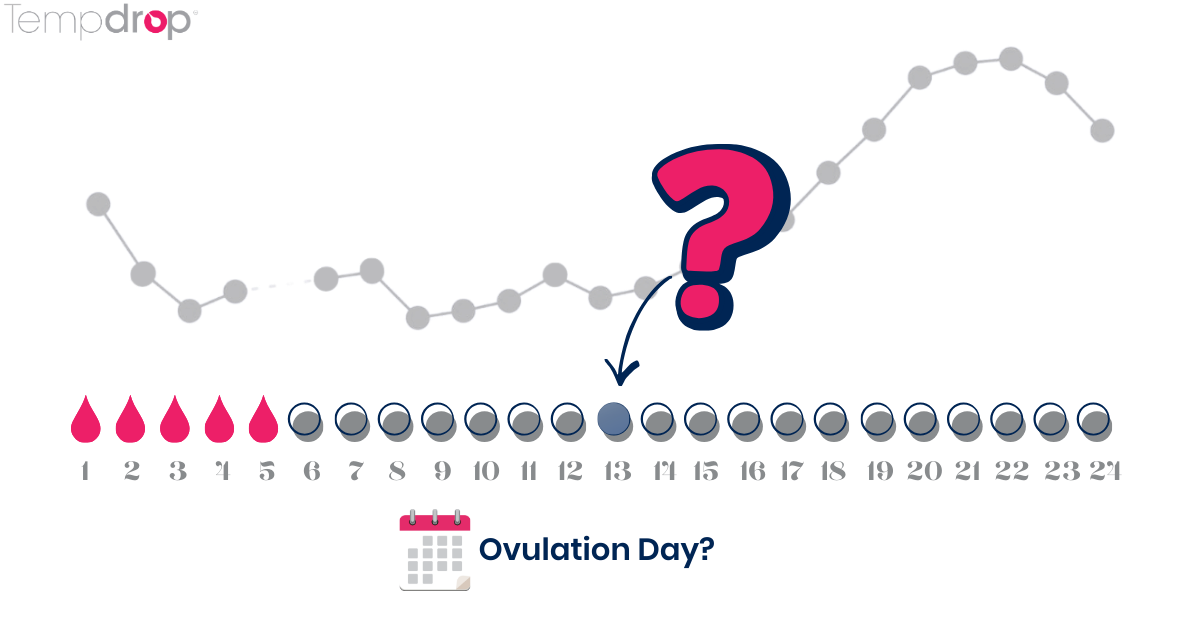
This is one of the most common (and understandable!) questions asked. But here’s the truth:
At-home fertility tracking can’t pinpoint the exact day of ovulation with 100% certainty. This is only possible with a well-timed ultrasound series. Instead, fertility charting helps us confirm that ovulation has passed and then we can make an educated guess about the timing of an ovulation window (usually spanning the most likely 3-4 days).
Here's what your charting clues can tell us:
- Temperature shift:
Ovulation typically occurs 1 to 3 days before your temperature rise.
- LH surge:
Ovulation usually occurs within 12 to 36 hours after a positive LH test.
- Peak cervical mucus (CM):
Ovulation often happens on or close to the last day of peak-type CM.
However all of these signs can vary in relation to ovulation so none are 100% accurate for pinpointing the day of ovulation*.
📝The Tempdrop app will mark the day before temp shift as a statistically likely possibility.
The goal of charting is not to identify ovulation day with precision, but to identify when fertility is high, confirm ovulation was successful and then, look back to apply an educated guess of the window in which ovulation likely occurred. Once the ovulation window is identified, choose any day from that window to start your luteal phase (days past ovulation) count.
💡For consistency, you may wish to start your DPO count from the day after same fertile sign (LH, Peak CM day or BBT shift) each cycle.

* Studies with ultrasound have confirmed that follicle rupture can occur before, during or after any at-home fertility sign is observed.